


You pushed hard at the gym yesterday. Maybe you increased your deadlift weight or tried a new HIIT class. Today, waking up is a struggle. Walking down the stairs feels like a specialized form of torture.
We have all been there. But as you waddle around the house, a question pops into your head: “Did I have a great workout, or did I actually injure myself?”
At Bellefleur Physiotherapy in Rockland, we see this confusion daily. There is a fine line between the microscopic tears that build strength and the muscle strains that require rehabilitation. Here is how to tell the difference and how to recover the right way.
What Are Microtears? (The Science of “Gains”)
To build stronger muscles, you first have to break them down.
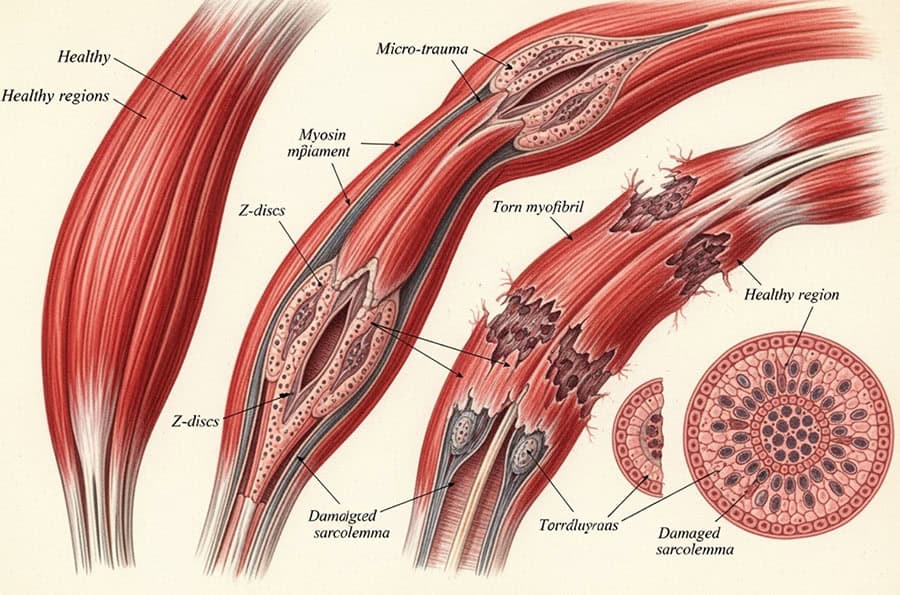
When you lift weights or perform resistance training, you create microscopic trauma in your muscle fibers. These are called microtears.
This sounds scary, but it is actually the goal. Your body responds to this “damage” by rushing nutrients and blood to the area to repair the fibers. Crucially, your body doesn’t just patch them up to their previous level; it rebuilds them thicker and stronger to handle that stress better next time. This process is called hypertrophy.
 The “Good” Pain: DOMS
That stiffness you feel 24 to 48 hours after a workout? That is Delayed Onset Muscle Soreness (DOMS).
DOMS is the classic sign of microtears. It is your body’s inflammatory response working to repair the muscle.
-
How it feels: A dull, aching pain or tightness.
-
Timeline: Starts 12–24 hours after exercise, peaks at 48 hours, and fades by day 3 or 4.
-
The Test: The pain is usually symmetrical (e.g., both quads hurt after squatting) and improves slightly once you get moving and warm up.
The “Bad” Pain: Muscle Strains
While microtears are normal, macrotears (strains) are not. This happens when the muscle fibers are stretched beyond their limit or torn significantly.
You might be dealing with an injury if:
-
The Pain is Sharp: It feels like a stabbing or “electric” sensation, not a dull ache.
-
It Happens Immediately: Unlike DOMS, which creeps up on you, injury pain often strikes during the exercise.
-
It is Asymmetrical: If your right shoulder is screaming in pain but your left one is fine after a bench press, that is a red flag.
-
Loss of Function: If you physically cannot lift your arm or put weight on your leg, that is not “post-workout stiffness”—that is a medical issue.
4 Rules for Faster Recovery
Whether you are dealing with intense DOMS or just want to get back to training sooner, recovery is active, not passive.
1. Prioritize Protein
Your muscles are made of protein. You cannot rebuild a brick wall without bricks. Ensure you are hitting your protein requirements for athletes immediately after your workout to jumpstart the repair process.
2. Keep Moving (Active Recovery)
The worst thing you can do for stiff muscles is sit on the couch all day. “Motion is lotion.” Go for a light walk, a gentle swim, or a bike ride around Rockland. Gentle movement flushes out metabolic waste and brings oxygenated blood to the repairing tissues.
3. Sleep is Non-Negotiable
You don’t build muscle in the gym; you build it in bed. Growth hormone—the primary hormone responsible for tissue repair—is released almost exclusively during deep sleep. If you are cutting sleep, you are cutting your results.
4. Use Heat for Stiffness
Once the initial 48 hours have passed, heat is your best friend for microtears. It expands blood vessels and relaxes tight tissues. (Confused about ice vs. heat? Read our guide on pain management and inflammation).
When to See a Physio
If your “soreness” hasn’t gone away after 4 days, or if the pain is sharp and limiting your movement, you need to get it checked. Ignoring a muscle strain can lead to chronic weakness and scar tissue buildup.
At our Rockland Physiotherapy clinic, we can assess whether you are dealing with normal training fatigue or an underlying injury. We use techniques like Dry Needling to release deep muscle knots and manual therapy to ensure your tissue heals correctly.
Don’t let “bad pain” keep you from your goals. Book your assessment at Bellefleur Rockland today.

Latest posts by Jason Bellefleur (see all)
- Spring Into Action: How to Safely Achieve Your Fitness Goals This Year - April 9, 2026
- Plantar Fasciitis Relief: An Ottawa Physio’s Guide to Heel Pain - March 28, 2026
- Pain Behind the Knee: Common Causes and When to See a Physio - March 4, 2026